What do a manufacturer of horse transport vehicles, a glassmaker founded under Louis XIII, a liqueur from Fécamp, a legendary automotive brand, a notebook manufacturer, a specialist in waste bags and a world expert in acacia gum all have in common?
Beyond their Norman roots, all these companies have survived decades – and in some cases centuries – by doing far more than simply preserving their heritage. They have transformed their businesses, anticipated changes in their markets, invested, innovated and expanded internationally.
This is the story told by Le Journal des Entreprises in its feature on “Entrepreneurial Sagas: These Normandy Companies That Have Defied Time”, devoted to some of the region’s most iconic businesses.
Their stories are very different, but they share one common thread: behind longevity often lie decisive choices and a certain degree of entrepreneurial boldness.
Théault: A Century of Reinventing Horse Transport
The key to its longevity? Transforming artisanal expertise into highly specialised industrial know-how, while continually adapting its products to changing uses and customer expectations.
It all began in 1924 in Avranches, when Émile Théault set up as a wheelwright and coachbuilder on the family farm. Carts, rubbish wagons and livestock trailers formed the everyday business of the workshop.
But rather than remaining tied to its original trade, the company evolved with the times. Horse-drawn trailers gave way to motorised vehicles, and Théault gradually specialised in equine transport.
Even the destruction caused by the 1944 bombings did not bring the adventure to an end. The company rebuilt and continued its specialisation, with innovation as a constant thread: adapting the Citroën Type H, developing technical solutions designed around horse comfort and safety, and progressively moving upmarket.
A century later, Théault has become an international benchmark in premium equine transport, with its vehicles described as the “Rolls-Royce of horse transport”.
Pochet du Courval: Four Centuries and Still Ahead of Its Time
The key to its longevity? Never treating historical expertise as something fixed. At Pochet du Courval, preserving excellence in glassmaking depends on the ability to transform its industrial capabilities.
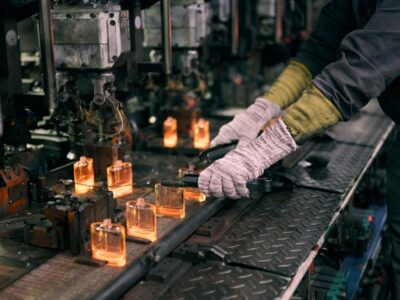
In 1623, in the Bresle Valley, François Le Vaillant was granted permission to establish a glass-making factory. More than four centuries later, Pochet du Courval is still manufacturing glass in Normandy and supplying the world’s leading perfume houses.
This exceptional longevity has been built on a succession of major industrial decisions.
With the growth of the perfume industry in the 19th century, the company moved into luxury fragrance bottles. In 1853, it notably produced Guerlain’s famous Bee Bottle for Empress Eugenie.
Then came industrialisation. In 1933, hand-blowing gave way to semi-automatic production. In 1971, the company’s leaders made a particularly ambitious decision: to invest the equivalent of an entire year’s turnover in a new automated factory in Guimerville.
More recently, the environmental transition has driven another technological leap. In 2022, the company invested €40 million in an electric furnace, the centrepiece of a €94 million decarbonisation programme.
Bénédictine: Thinking Brand and International Markets from the 19th Century
The key to its longevity? A remarkably modern insight for its time: a distinctive product alone is not enough. You also need to build a strong brand, protect it and think beyond your domestic market from the outset.
The history of Bénédictine is inseparable from that of Alexandre Le Grand. A wine and spirits merchant in Fécamp, he developed a liqueur in 1863 inspired by an ancient recipe combining herbs and spices.
But his boldness lay not only in the product itself. It was also reflected in the way he chose to market it.
As early as 1864, Alexandre Le Grand focused on the bottle, its presentation and the protection of the brand. He also quickly understood the power of advertising, still in its infancy at the time, and used his network of merchants to expand internationally from the very beginning.
Great Britain, Brazil and Mexico: Bénédictine was exported from its very first year on the market. By 1867, international sales had already overtaken those in France.
More than 160 years later, the recipe, made from 27 herbs and spices, remains secret, while exports remain central to the brand’s business model. Bénédictine is now owned by the Bacardi Group.
Alpine: Disappearing… Then Being Reborn
What makes this story distinctive? It demonstrates that the longevity of a brand does not necessarily mean uninterrupted activity. A sufficiently powerful heritage can provide the foundations for a renaissance – provided it can be reinterpreted for a new era.
Founded in Dieppe in 1955 by Jean Rédélé, Alpine was born from a conviction: motor racing could serve both as an exceptional testing ground and as a powerful showcase.
Jean Rédélé pursued lightness, agility and performance, while using as many standard production components as possible to keep costs under control. This approach gave rise, among other models, to the A110 in 1962, which would become the brand’s future icon.
But Alpine’s history has not been a straightforward one. After coming under Renault’s control in the 1970s, production came to an end in 1995.
It was not until 2012 that Renault launched the brand’s revival, followed in 2017 by the arrival of a new A110 on the market.
The next chapter brings another transformation: Alpine carrying its sporting heritage into the electric era. Through its “Dream Garage”, the brand is expanding its range while seeking to retain the principles imagined by Jean Rédélé: lightness, agility and driving pleasure.
Hamelin: Knowing When to Change Markets in Order to Keep Growing
The key to its longevity? Never hesitating to change the playing field. From transforming its business in the 1950s to today’s international acquisitions, Hamelin has repeatedly turned market changes into opportunities for growth.
When the Hamelin Group was founded in Caen in 1864, its business was far removed from the Oxford notebooks for which it is now known. The company specialised, among other things, in books and accounting ledgers.
In the 1950s, it identified a change in educational habits: the slate was gradually giving way to the exercise book. Hamelin seized the opportunity, changed direction and created the Conquérant brand.
This marked the beginning of a growth strategy built around acquisitions. Oxford joined the group in 1982. Forty years later, in 2023, Hamelin took another major step forward with the acquisition of Germany’s Pelikan Group.
The family-owned company from Caen now has two globally recognised brands – Oxford for notebooks and Pelikan for writing products – and continues its international expansion in search of new sources of growth beyond a European market facing a declining school-age population.
PTL: Transforming Rather Than Watching Its Market Disappear
The key to its longevity? A succession of radical transformations. PTL is a particularly striking example of a company’s ability to gradually abandon an established technology or business model and adopt a new one before it is too late.
PTL’s history began in Luneray in 1925. The Lardans brothers manufactured jute and linen bags, primarily for agriculture and industry.
But the arrival of plastic films gradually disrupted the market. PTL began experimenting with them in the 1960s before making a major shift in the 1970s, moving from textiles to polyethylene.
Acquired in 1982 by the family-owned Sphere Group while facing financial difficulties, the company recovered and continued to innovate. In 1987, its Alfapac brand developed Coulissac, presented as the first drawstring bin bag on the market.
Its story is also marked by a remarkable ability to recover from setbacks. A factory devastated by fire in 1994 was rebuilt within six months, before severe flooding struck the site again in 1999.
Faced with growing environmental challenges, PTL embarked on another transformation: compostable bags from 2006 onwards, plant-based materials, recycled content and eco-design.
One hundred years after its creation, the company has become Europe’s leading manufacturer of bin bags.
Alland & Robert: Turning a Single Product into Global Expertise
The key to its longevity? Choosing hyper-specialisation without ever becoming dependent on a single market. Rather than multiplying raw materials, Alland & Robert has multiplied the uses, applications and geographical markets for its acacia gum.
At Alland & Robert, everything begins with a single raw material: acacia gum.
In 1884, chemical engineer Francisque Alland was working on its use in the textile industry when he noticed that no French company imported it directly. He joined forces with Alfred Robert and turned that observation into a business opportunity.
The company survived the 1929 financial crisis and two world wars. After 1945, it did not simply resume business: it developed new processes for grinding and pulverising gum.
Another pivotal decision came in 1972, when Bernard Alland established a factory in Port-Mort, in the Eure department, close to the Seine and the ports of Le Havre and Rouen. At the same time, new opportunities were emerging in the food industry.
From the 1980s onwards, Frédéric Alland accelerated the company’s international expansion. Today, 95% of its turnover comes from exports, with customers in 75 countries.
The sixth generation continues this strategy, particularly through investment in R&D to expand the applications of a product that remains at the heart of the company’s business model: food, cosmetics, pharmaceuticals and nutrition.
Inheriting – But Above All, Continuing to Build
These seven stories span more than four centuries of Norman industry and entrepreneurship. Some of these companies remain family-owned, while others have joined major international groups. Some have remained faithful to the same product, while others have radically transformed their businesses.
Their longevity, therefore, cannot be explained by a single formula.
But one common lesson emerges from the stories told by Le Journal des Entreprises: defying time rarely means standing still.
Investing the equivalent of a year’s turnover in a new factory, switching from textiles to plastics, expanding internationally as early as the 19th century, acquiring competitors to reach a new scale, electrifying a historic automotive brand or constantly finding new applications for the same raw material: at key moments in their history, these companies have been willing to put at risk part of what had previously made them successful.
Heritage, expertise and territorial roots provide their foundations. But it is their ability to anticipate, make decisions and sometimes take risks that has allowed them, generation after generation, to continue writing their stories.
Source: Le Journal des Entreprises – “Entrepreneurial Sagas: These Normandy Companies That Have Defied Time”, along with profiles of Théault, Pochet du Courval, Bénédictine, Alpine, Hamelin, PTL and Alland & Robert, published between December 2025 and July 2026.